Loading...
Tooth Fillings
We fill cavities with tooth-coloured composite, which is mercury-free. Most fillings take one visit, and we tell you if the tooth needs more than a filling.

A filling replaces the part of a tooth lost to decay or a small break. The dentist removes the decayed part, cleans the cavity and rebuilds the tooth with filling material. Done early, it saves the tooth and stops the decay spreading to the nerve.
Fillings are part of general dentistry, and our dentists place them every day. We use tooth-coloured composite, which is mercury-free. It bonds to the tooth, so we remove less of it than older silver amalgam fillings needed.
Cavities rarely hurt until they are deep. We recommend a check-up if you notice a dark spot, a rough edge or food always trapped in one place.
When tooth fillings can help
- A brown or black spot on the biting surface
- Sensitivity to sweet, hot or cold food
- Food that keeps catching between two teeth
- A rough or sharp edge you can feel with your tongue
- A chipped tooth with no pain
- An old filling that has cracked, stained or fallen out
Your options
Composite filling
Tooth-coloured resin built up in layers and set with a curing light. It suits front and back teeth when the cavity is small to medium. It can wear or stain over time.
Crown instead
When a filling would be larger than the remaining tooth, a crown holds the tooth together better. We decide this after removing the decay, and we explain why.
What happens, step by step
- 1
Exam and X-ray
We look at the tooth and take a LASER RVG X-ray where a cavity may sit between teeth or under an old filling. We show you the image and explain what we see.
- 2
Numbing and cleaning the cavity
We numb the area with local anaesthesia and remove the decay. You feel vibration and pressure. Tell us if you feel anything sharp.
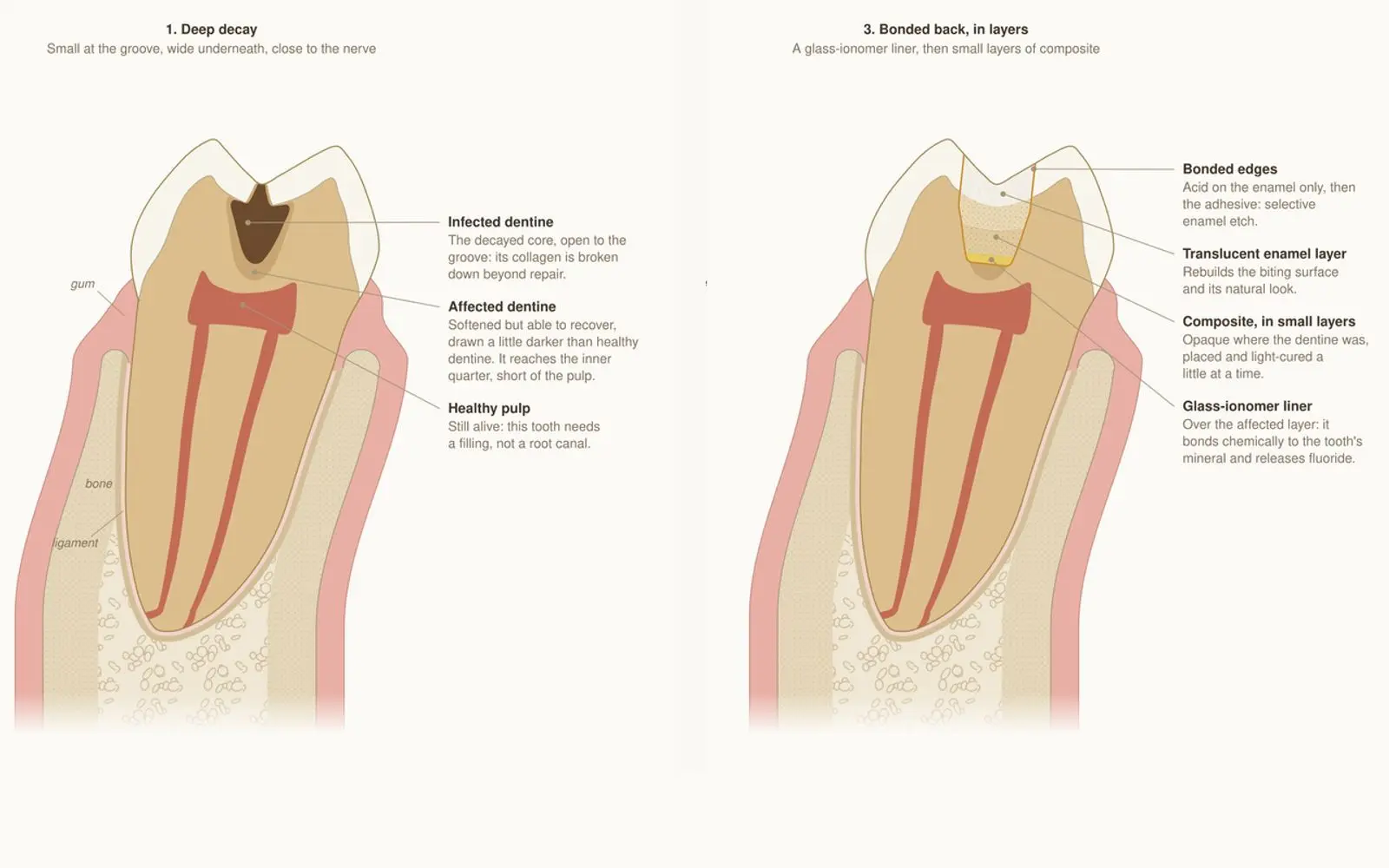
Left: decay under the groove, close to the nerve. Right: the same tooth with the decay removed and a tooth-coloured filling built up in layers. Illustration: Khalid Aletaibi, Wikimedia Commons (CC BY 4.0), two panels cropped and combined - 3
Building the filling
The composite is placed in layers, each set under a blue light for a few seconds. This is quick, and the tooth is shaped to fit your bite.
- 4
Bite check and polish
We ask you to bite on thin paper to find any high spot, then polish. A filling that feels high is easy to adjust, so say so before you leave.

From our case studies
All case studies →

Several decayed teeth, restored in 45 minutes
Composite fillings on all affected teeth


Matching two front teeth
Composite filling on tooth 11 and a zirconia crown on the adjacent central incisor
Real cases from our clinic, shared with each patient's consent. Results differ from person to person.
Real Patient Results
View full gallery →

Composite restoration case 3
← Swipe to compare →


Composite restoration case 4
← Swipe to compare →
After treatment
- Wait until the numbness has gone before eating, usually two to three hours
- Mild sensitivity to cold for a few days is normal
- Tell us if the tooth feels high when you bite, because it is a quick fix
- Brush twice a day and floss around the filling
- Cut down on sugary snacks between meals, since new decay can start at the filling edge
When we suggest something else
If the cavity is very large or the tooth is cracked, a filling can break. In that case we suggest a crown, which covers and holds the tooth together. If decay has reached the nerve, the tooth needs a root canal first.
Very early decay that has not formed a hole can sometimes be managed with fluoride and better cleaning, with no drilling. We check this with you at a review.
Cost
Typical cost across Mumbai
- Composite filling, per tooth
- ₹1,000 to ₹2,500
Larger cavities and back teeth cost more.
Ranges published by Mumbai clinics and price guides, checked October 2026: ClinicSpots, Sabka Dentist. These are not our prices.
What changes the cost
- The size of the cavity and how many surfaces it covers
- Which tooth it is and how hard it is to reach
- The number of teeth being filled
- Whether the tooth also needs a root canal or crown
- Whether an old filling must be removed and replaced
Visit us for a detailed quote. We examine your teeth and give you a written estimate before any treatment starts.
Who treats you
- Dr. Kanchan Koli, General Dentistry Specialist (BDS)
Questions patients ask
Does getting a filling hurt?
The tooth is numbed, so you usually feel vibration and pressure rather than pain. The injection can sting for a moment. Teeth may feel sensitive for a few days.
Are composite fillings safe?
Yes. They contain no mercury. They are widely used in dentistry and are the usual choice for visible teeth.
How long do fillings last?
It varies with the size of the filling, your bite and how well you clean. Many last years, but they can wear or chip. New decay at the edge is the usual reason one needs replacing.
Can several cavities be filled at once?
Often yes. In one of our cases, a patient with decay across several front teeth had all of them restored in a single 45-minute session.
Why does my filled tooth hurt when I bite?
Most often the filling is slightly high. A quick adjustment fixes it. If the pain lingers, the nerve may be irritated, and you should come in.
Can I eat right after a filling?
Composite sets under the light straight away, but wait until the numbness has worn off to avoid biting your cheek.
Typical Duration
Usually 30 to 60 minutes, often one visit
Visit Us in Malad West
A-102, Marve Link Appt., 1st Floor, Marve Road, Mith Chowky, Malad (W), Mumbai 400064
- Monday – Saturday: 10:30 AM – 8:00 PM
- Sunday: Closed