Loading...
Root Canal Treatment
Root canal treatment removes an infected or damaged nerve from inside a tooth so you can keep the tooth. We use local anaesthesia and check the roots on digital X-ray.

Inside every tooth is soft tissue called the pulp, which holds its nerve and blood supply. When decay, a crack or an injury reaches it, the pulp can die or become infected. Root canal treatment cleans out that tissue and seals the empty canals, so the tooth can stay in your mouth.
At our Malad West clinic, our dentists treat teeth under local anaesthesia. We take a LASER RVG X-ray first, because the shape and number of canals decides how long the work takes.
Treatment is the usual way to avoid extraction. The aim is to keep the tooth, and we explain the plan before we start.
When root canal treatment can help
- A toothache that wakes you at night or lingers after hot or cold
- Pain when you bite down on one tooth
- A tooth that has darkened compared with its neighbours
- Swelling or a pimple-like bump on the gum near the tooth
- A deep cavity or a broken tooth that exposes the inner part
- A tooth that hurt badly and then suddenly stopped hurting, which can mean the nerve has died
What happens, step by step
- 1
First visit: exam and X-ray
We test the tooth, take a LASER RVG X-ray and confirm that a root canal is what it needs. Whether we can begin the same day depends on the tooth and that day's schedule.
- 2
Numbing and cleaning the canals
The tooth is numbed with local anaesthesia. We make a small opening, remove the pulp and clean the canals with fine instruments and irrigating solutions. You usually feel pressure and vibration, and should tell us if anything hurts.
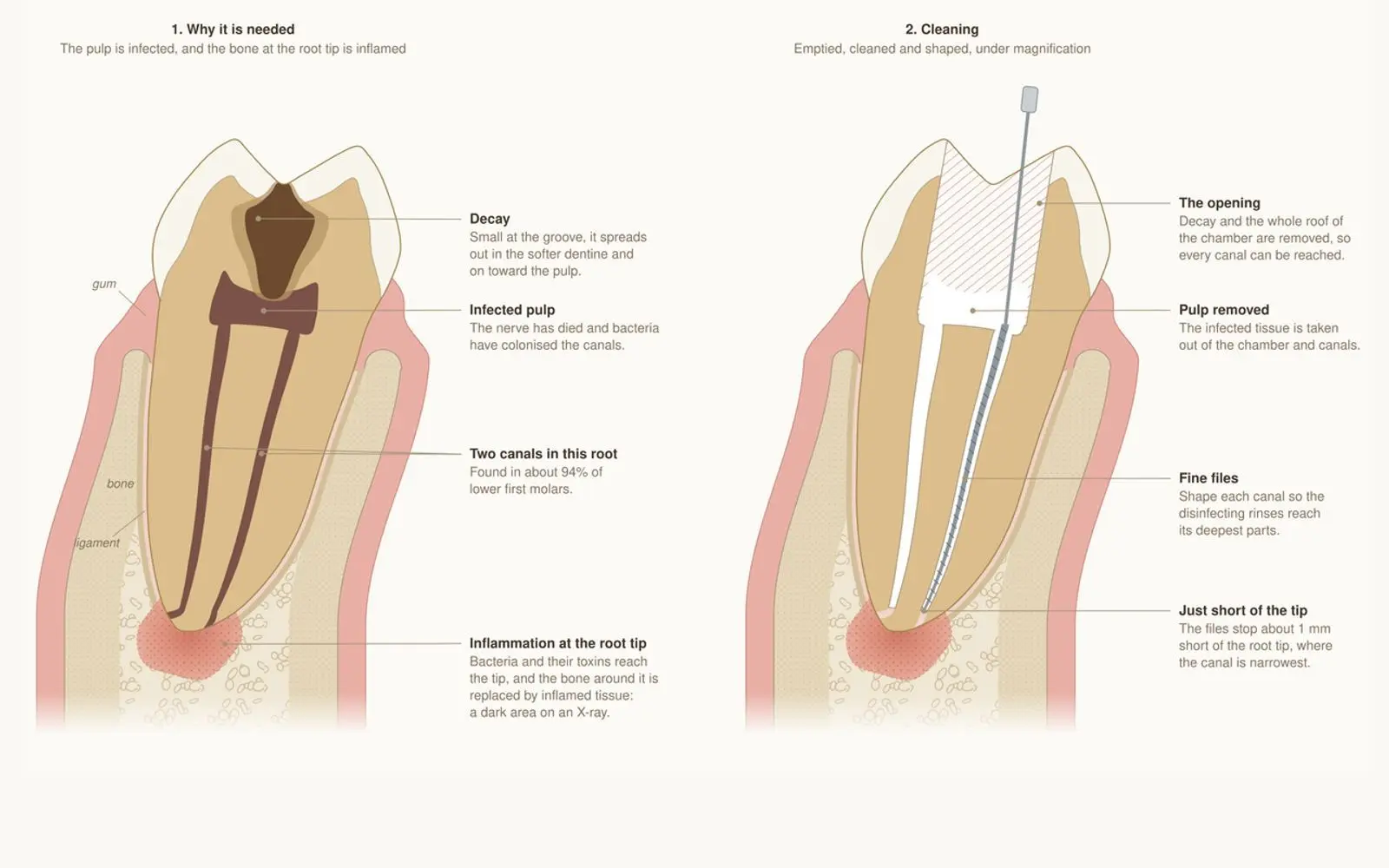
Left: decay has reached the nerve and the bone at the root tip is inflamed. Right: the nerve removed and the canal cleaned and shaped to its tip. Illustration: Khalid Aletaibi, Wikimedia Commons (CC BY 4.0), two panels cropped and combined - 3
Filling and sealing
The canals are filled with a biocompatible material and the tooth is sealed. Where a tooth is badly infected, we may place medicine in it and finish at a second visit.
- 4
Crown or final restoration
A treated tooth is more brittle. Back teeth nearly always need a crown, and front teeth sometimes do. We plan this at the start so the tooth is protected soon after.

From our case studies
All case studies →

Dirk's broken front tooth
Root canal treatment on 3 teeth, a porcelain crown on the central incisor, and laminates on the lateral incisors


Whitening and a crown for Dhiren, visiting from the USA
Full mouth bleaching, root canal treatment, and a zirconia crown on a lower front tooth


Akshay's uneven front teeth
Root canal treatment and metal-free ceramic crowns on both lateral incisors, and laminates on the central incisors and canines
Real cases from our clinic, shared with each patient's consent. Results differ from person to person.
After treatment
- Do not eat on that side until the numbness has gone, to avoid biting your cheek or tongue
- Mild soreness for a few days is common and usually settles with ordinary pain relief
- Take any antibiotics exactly as prescribed
- Avoid chewing hard food on the tooth until the crown is fitted
- Return for the crown on time; a tooth left unprotected can fracture
- Call us if swelling, fever or severe pain returns
When we suggest something else
Extraction is the alternative, and we use it when a tooth cannot be saved: a crack that runs into the root, too little tooth left above the gum, or bone loss around the root. Pulling a tooth is quicker, but the gap then usually needs a bridge or an implant, which can cost more over time.
If the infection has come back in a tooth that was treated years ago, we may recommend retreatment before considering extraction. We look at the X-ray and tell you which is more likely to work.
Cost
Typical cost across Mumbai
- Root canal, per tooth (crown not included)
- ₹3,500 to ₹10,000
Back teeth with more canals cost more than front teeth, and a crown is usually extra.
Ranges published by Mumbai clinics and price guides, checked October 2026: ClinicSpots, Sabka Dentist. These are not our prices.
What changes the cost
- Which tooth it is, because back teeth have more canals
- How many visits the infection requires
- Whether the tooth has been treated before and needs retreatment
- Whether a post or core build-up is needed
- The crown that follows, and the material you choose for it
Visit us for a detailed quote. We examine your teeth and give you a written estimate before any treatment starts.
Who treats you
- Dr. Kanchan Koli, General Dentistry Specialist (BDS)
- Dr. (Lt.Col) Suresh Isawe, Founder & Senior Surgeon (BDS (Mumbai, 1981), PGDPC, MIAO (USA))
Questions patients ask
Does a root canal hurt?
The tooth is numbed with local anaesthesia, so you usually feel pressure and vibration rather than sharp pain. The area may be sore for a few days afterward. The pain that sends people in comes from the infection, not from the treatment.
How long does a root canal take?
A simple front tooth can often be done in one sitting of about an hour. Molars with more canals, or teeth with active infection, may need two or three visits.
Can I eat after a root canal?
Wait until the numbness wears off, then eat soft food. Avoid chewing hard things on that tooth until the crown or final filling is in place.
Do I always need a crown afterwards?
Back teeth nearly always do, since they take the heaviest bite. Front teeth with little damage may only need a filling. We tell you which applies to yours.
Is it safer to just pull the tooth?
Not usually. Saving a natural tooth is generally the better choice when it can be saved. Extraction is the right call if the tooth is too broken or the root is cracked.
Can a treated tooth get infected again?
Yes, if the seal leaks or the tooth fractures. A timely crown and good cleaning reduce that risk. Retreatment is often possible.
Typical Duration
Usually 1 to 3 visits
Visit Us in Malad West
A-102, Marve Link Appt., 1st Floor, Marve Road, Mith Chowky, Malad (W), Mumbai 400064
- Monday – Saturday: 10:30 AM – 8:00 PM
- Sunday: Closed