Most people first hear about laser dentistry when a clinic advertises it, which makes it easy to assume it is a marketing term. It is not. A dental laser is a specific piece of equipment, it is regulated, and it does a narrow set of jobs well. It also has real limits.
There are two different kinds of dental laser, and they do almost opposite things. One removes and reshapes tissue. The other leaves tissue completely intact and encourages it to heal. Knowing which one your treatment involves tells you most of what you need to know about what the appointment will feel like.
What a dental laser actually is
LASER stands for Light Amplification by Stimulated Emission of Radiation. In practice it is a narrow beam of light energy delivered through a handpiece, tuned to a wavelength that the target tissue absorbs. Because the energy is absorbed exactly where it is aimed, the surrounding tissue is largely left alone.
Lasers have been used in dentistry since the US Food and Drug Administration first cleared them for dental use in the 1990s. Some lasers are designed for soft tissue such as gums, some for hard tissue such as enamel, and some for both. In everyday practice, soft tissue work is where lasers are used most.
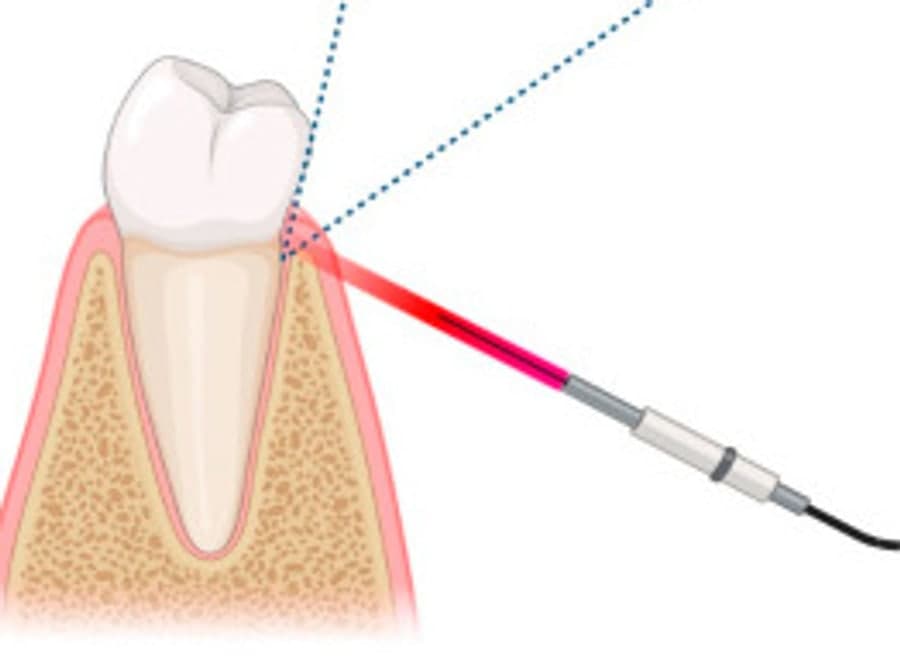
The two types, and why the difference matters
Surgical lasers (HLLT)
High intensity laser treatment uses enough energy to cut, remove, or reshape tissue. It replaces the scalpel in a number of small gum procedures. As it works, the laser tends to seal small blood vessels, which is why these procedures usually bleed very little and often need no stitches.
This is the laser used for gum reshaping, releasing a tongue or lip tie, treating dark gums, and removing small growths such as a fibroma.
Non-surgical lasers (LLLT, also called photobiomodulation)
Low reactive-level laser treatment uses far less energy. It does not cut anything. The light passes into the tissue and stimulates cell activity, which is used to reduce inflammation, relieve pain, and support healing. Published reviews of photobiomodulation in dentistry report improvements in the speed and quality of tissue repair, along with anti-inflammatory and pain-relieving effects.
The evidence base is strongest for managing painful oral conditions such as mouth ulcers and oral mucositis. It is also used after surgical procedures to support recovery, and for tooth sensitivity.
What we treat with a laser at Gurukrupa Dental
We use both types at our Malad West clinic, and treat patients from across Malad East, Kandivali, Goregaon and the wider western suburbs. These are the procedures a laser is genuinely suited to, and they sit under our laser dentistry service:
- Dark gum treatment (melanin depigmentation)
- Gummy smile correction by reshaping the gum line
- Frenectomy to release a tongue tie or lip tie
- Gum disease treatment including pocket disinfection and curettage
- Gingivectomy and gingivoplasty to recontour gum tissue
- Laser teeth whitening
- Root canal sterilisation and peri-implant sterilisation
- Ulcer management and treatment of fibromas and abscesses
Laser compared with conventional treatment
This is not an argument that a laser is always the better option. It is not suitable for every case, it cannot replace a filling or a crown, and some procedures are still done better with conventional instruments. The right question is whether a laser suits your specific problem, which is a clinical decision, not a preference.
The procedures patients ask about most
Dark gums
Gums can look brown or patchy black because of natural melanin pigmentation. It is harmless. Some people simply dislike how it looks, particularly if they have a high smile line and the gums show. A surgical laser removes the thin pigmented surface layer so the tissue heals back lighter. Pigment can return over time in some people.
Tongue tie and lip tie
A tight band of tissue under the tongue or lip can restrict movement, and in infants it can interfere with feeding. Releasing it with a laser is quick, bleeds very little, and usually needs no stitches, which is the main reason lasers are commonly chosen for this procedure.
Gummy smile
If a lot of gum shows when you smile, the teeth can look short even when they are a normal length. Where the cause is excess gum tissue, reshaping the gum line exposes more of the tooth. Where the cause is the jaw or the lip, a laser will not fix it, so this needs proper assessment before anything is planned.
Gum disease
In gum disease, bacteria collect in pockets between the tooth and gum. A laser can disinfect those pockets and remove diseased tissue lining them. It is used alongside cleaning and scaling, not instead of it, and it does not remove the need for good daily hygiene at home. Advanced cases are treated through our general dentistry service.
What affects the cost
We do not publish a single price, because laser procedures vary too much for one number to be honest. What actually moves the cost:
- How much area is treated. Depigmenting both arches costs more than a small section.
- Whether it is one visit or several. Gum disease treatment is usually staged across appointments.
- Whether other treatment is needed first, such as scaling before gum therapy.
- Which laser is used, since surgical and low-level procedures are not the same work.
You get a written treatment plan with costs before anything begins, and we will tell you if a conventional approach would do the same job for less. If you are comparing quotes across Malad, Kandivali or Goregaon, ask each clinic what is included, because a low headline figure often excludes the follow-up visits.
What happens at your appointment
Assessment
We examine the area and confirm whether laser treatment is appropriate for your condition. If it is not, we will tell you and explain what we would do instead.
Preparation
Minimal preparation is needed. Many soft tissue procedures require little or no anaesthesia. You and the clinical team wear protective eyewear for the duration.
Treatment
The laser is applied to the treatment area. A surgical laser removes or reshapes tissue. A low-level laser is held over the area to stimulate healing. Most of these procedures take 30 to 60 minutes.
Recovery
You are given aftercare instructions before you leave. Most patients return to normal activities the same day, with any tenderness settling over the following days.
What you do not need to worry about
Most of the anxiety around dental lasers comes from the word itself. These are the concerns patients raise most often, and honestly, they are not the ones worth having:
- It is not the radiation you are thinking of. A dental laser is focused light. It is not ionising radiation like an X-ray, and it does not carry that kind of risk.
- It will not burn your mouth. The wavelength is chosen so the target tissue absorbs the energy and the surrounding tissue largely does not. That selectivity is the whole reason lasers are used.
- It is not experimental. Lasers have been cleared for dental use since the 1990s and are ordinary equipment in dentistry now, not a novelty.
- You will usually not need stitches, and gum procedures normally bleed very little, because the laser tends to seal small vessels as it works.
- Most people carry on with their day. These are typically 30 to 60 minute appointments and patients usually return to normal activities the same day.
What is worth being careful about
- Case selection matters more than the machine. A laser in the wrong case is worse than a conventional instrument in the right one. If we would get a better result another way, we will tell you.
- Results are not always permanent. Gum pigmentation can return over months or years in some people. That is normal, not a failed treatment.
- Your medical history genuinely matters. Some conditions and medications affect healing, so tell us everything, including supplements.
- Eye protection is not optional. You and the clinical team wear it for the whole procedure. That is the one real hazard of a dental laser, and it is fully controlled.
- Aftercare decides the outcome. Gum treatment does not remove the need for daily brushing and flossing at home.
Is laser dentistry safe?
Dental lasers have been cleared for dental use since the 1990s and have a long safety record when used by trained clinicians. Protective eyewear is worn throughout, because the risk that matters most with a dental laser is eye exposure, not the tissue itself.
As with any procedure, it depends on correct case selection. Some medical conditions and medications affect healing, so tell us your full medical history. If a laser is not the right tool for your problem, the honest answer is to use something else.
Recovery
Soft tissue laser procedures generally heal faster than the equivalent conventional surgery, often within a few days. Expect some tenderness. Stick to soft foods for a day or two if you have had gum tissue treated, keep the area clean, and follow the specific aftercare you are given. If pain increases rather than settles, contact us rather than waiting.
How laser treatment is done at Gurukrupa
We have been treating patients in Malad West since 2000, and the clinic is ISO 9001 certified, which means our clinical and sterilisation protocols are documented and independently audited rather than simply asserted.
- Both laser types are available here. We run surgical (HLLT) and non-surgical (LLLT) systems, so the choice is driven by your case rather than by whichever machine happens to be in the room.
- The case is assessed before the laser is offered. If a conventional instrument would give you a better result, that is what we will recommend.
- Laser treatment is carried out by Dr. Suresh Isawe and Dr. Kanchan Koli. Dr. Isawe is the clinic's founder and senior surgeon, in practice since 1981 and previously a Commissioned Officer in the Indian Army Dental Corps for 26 years. Dr. Koli is certified in laser dentistry and handles much of the day-to-day laser work.
- Protective eyewear is worn by everyone in the room, for the whole procedure, every time.
- You get a written plan with costs before anything begins.
You can see the full scope on our laser dentistry service page, and real before and after cases, including gum depigmentation and frenectomy, in the smile gallery.
Common questions
Does laser treatment hurt?
Many soft tissue laser procedures need little or no anaesthesia, and most patients report only mild discomfort. Where anaesthesia is appropriate we use it. We will tell you beforehand what to expect rather than promise you will feel nothing.
Will my dark gums stay pink permanently?
Not always. Depigmentation removes the pigmented surface layer and the tissue heals lighter, but melanin can return over months or years in some people. It is a genuine improvement, not a permanent guarantee.
How long is recovery?
Soft tissue laser procedures generally heal faster than the conventional equivalent, often within a few days. Expect some tenderness and stick to soft foods for a day or two after gum work.
Is a laser better than conventional treatment?
For some procedures it is less invasive with faster healing. For others a conventional instrument does the job better, and a laser cannot replace a filling or a crown. It depends on the specific problem, which is a clinical decision.
Can a laser fix my gummy smile?
Only if excess gum tissue is the cause. If the cause is the jaw or the lip, reshaping the gum line will not fix it, which is why the case needs assessing before anything is planned.
Do you treat patients from outside Malad West?
Yes. We are on Marve Road at Mith Chowky and regularly see patients from Malad East, Kandivali East and West, Goregaon and across Mumbai.
Sources
- Laser Dentistry: What It Is and How It Works - Cleveland Clinic
- Photobiomodulation in dentistry: mechanisms, clinical applications and evidence-based guidelines - National Library of Medicine
- Implementation of Low-Level Laser Therapy in Dentistry: A Review - National Library of Medicine
Not sure if a laser is right for your case?
Bring us the problem rather than the treatment. We will examine the area, tell you whether a laser is the appropriate tool, and explain the alternatives if it is not. Our clinic is on Marve Road at Mith Chowky, Malad West.