Loading...
Dental Bridges
A bridge fills the gap from a missing tooth by joining a false tooth to crowns on its neighbours. We also tell you when an implant or denture is the better choice.

A dental bridge replaces one or more missing teeth without surgery. The teeth on either side of the gap are shaped and crowned, and the false tooth between them is joined to those crowns as a single piece. It is cemented in and does not come out.
The catch is the neighbouring teeth. They must be healthy enough to carry the load, and we have to trim them. That is the first thing we check, and it decides whether a bridge, an implant or a denture is right for you.
If a bridge suits you, we plan how the gum meets the false tooth so that food does not collect under it and the bite is even.

When dental bridges can help
- You have lost one or two teeth and the teeth beside the gap are strong
- Neighbouring teeth already have large fillings or crowns
- You do not want surgery or cannot have it now
- An older bridge has cracked, loosened or changed colour
- A tooth has drifted or tilted into the gap and chewing has become awkward
- You want a fixed solution rather than a denture you remove each night
Your options
Zirconia bridge
A metal-free ceramic framework that is strong enough for longer spans and back teeth. We made a full-mouth set of zirconia crowns and bridges for one patient whose old bridgework had cracked.
Zirconia with E-max layering
Zirconia gives strength and E-max gives a natural surface. For one patient with a cleft palate we added pink ceramic where gum was missing, so the gaps that caught food were closed.
Metal-ceramic bridge
Porcelain over a metal frame. It is an older option that usually costs less, but the metal can show at the gum line as years pass.
What happens, step by step
- 1
Exam and X-ray
We take a LASER RVG X-ray to check the roots and bone of the teeth that will hold the bridge. Teeth that need a root canal or gum treatment are dealt with first.
- 2
Shaping the neighbouring teeth
Under local anaesthesia the two anchor teeth are shaped and impressions taken. This usually takes about an hour, and you feel pressure rather than pain.
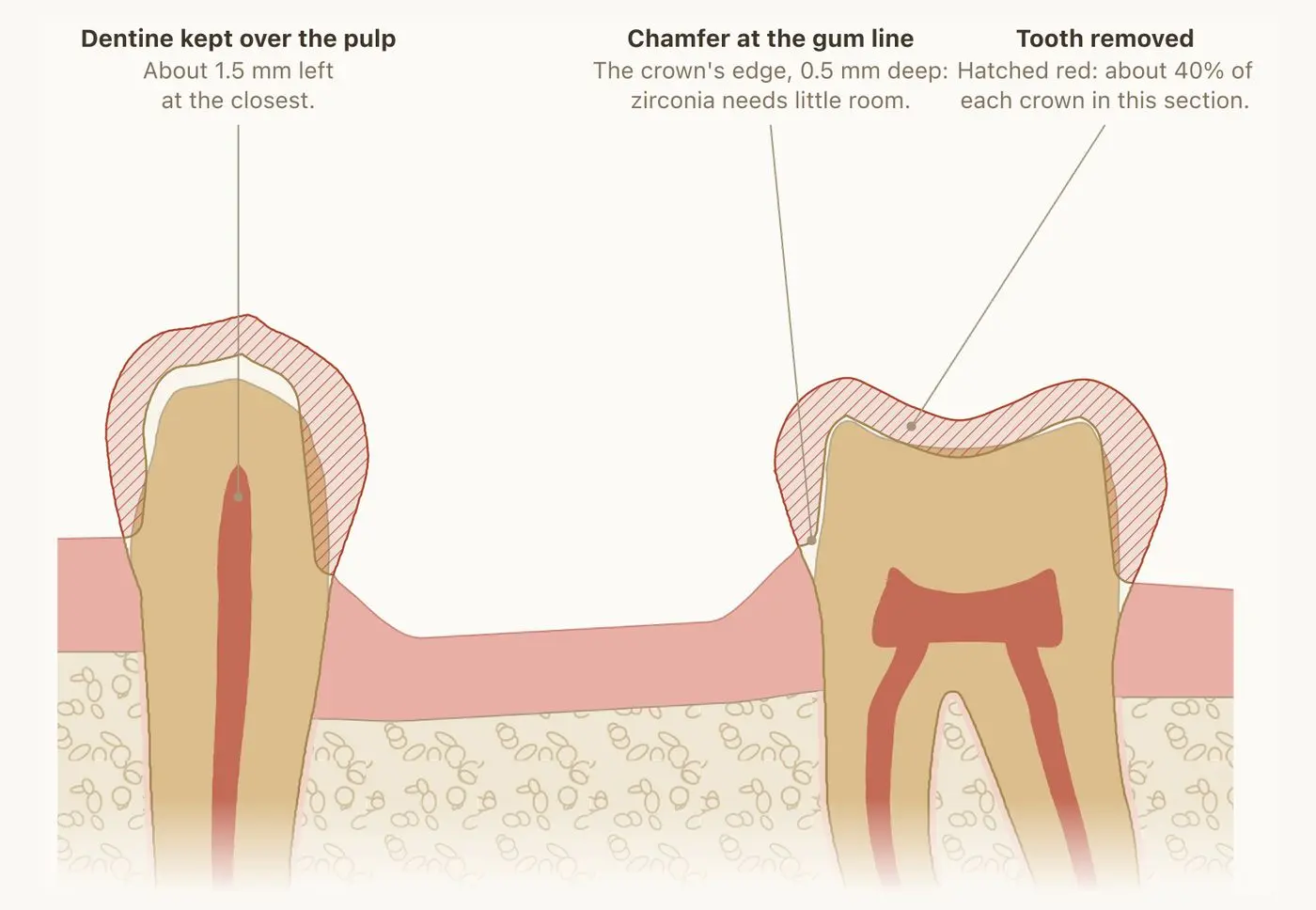
The two teeth beside a gap, cut lengthways. The red hatching shows how much of each tooth is shaped away to take a crown. Illustration: Khalid Aletaibi, Wikimedia Commons (CC BY 4.0), one panel cropped - 3
Temporary bridge
A temporary bridge covers the gap while the lab makes the final one. It is weaker than the final bridge, so keep to soft food.
- 4
Fitting
We try in the bridge, check the bite and shade, and cement it. We also show you how to clean underneath it.
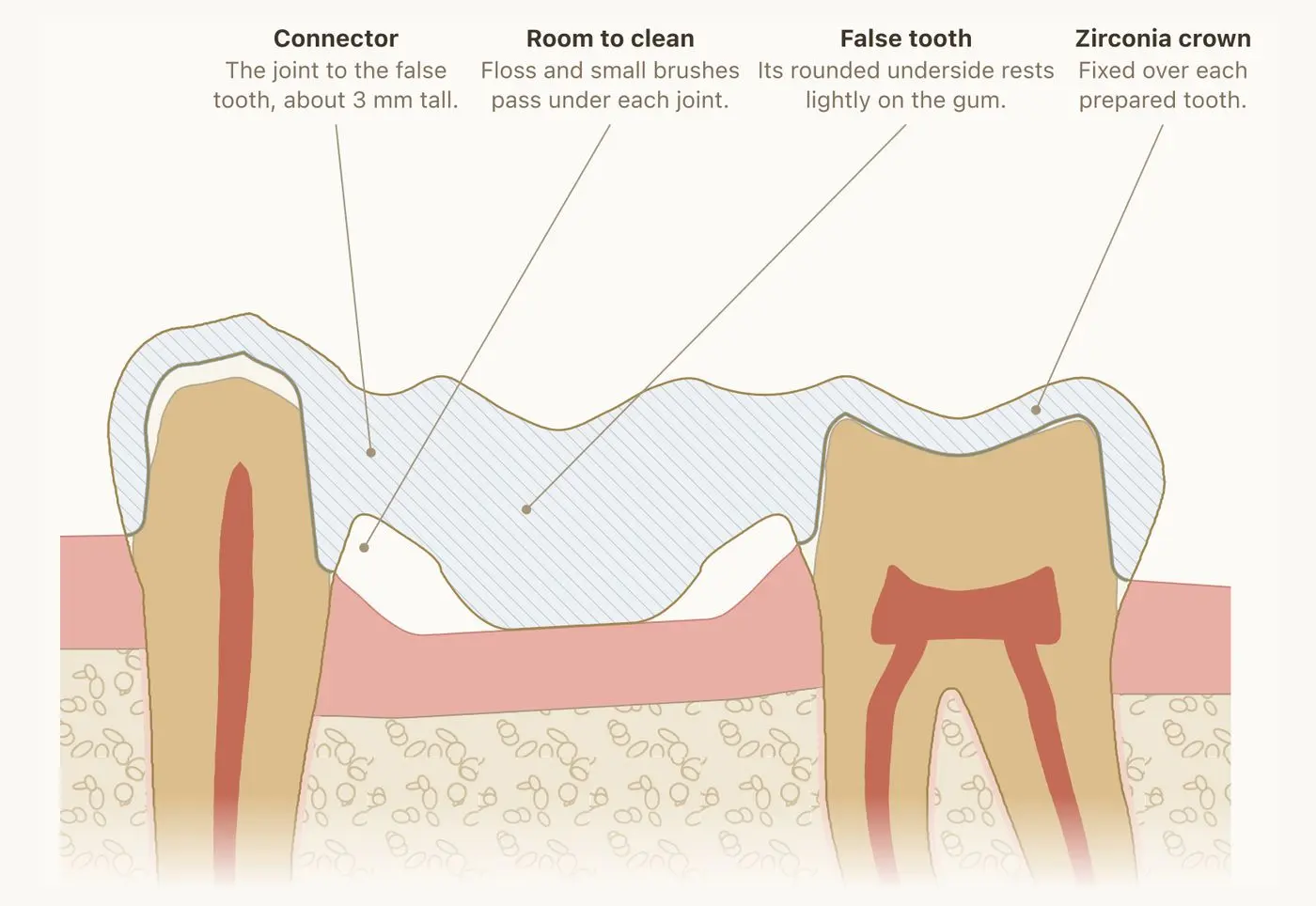
The finished bridge in the same view: a crown on each neighbouring tooth, joined to a false tooth that rests lightly on the gum with room to clean beneath it. Illustration: Khalid Aletaibi, Wikimedia Commons (CC BY 4.0), one panel cropped


From our case studies
All case studies →

A new bridge for Mrunal's cleft palate
4-unit Lava bridge with E-max layering and pink ceramic gum


Sangita's old bridgework had reached its end
Full mouth zirconia crowns and bridges


Jyoti swapped her denture for implants
2 Nobel Biocare implants with an implant-supported zirconia bridge, E-max layered
Real cases from our clinic, shared with each patient's consent. Results differ from person to person.
After treatment
- Clean under the false tooth every day with floss threaders, a superfloss or an interdental brush
- Avoid very hard or sticky food in the first week
- Expect a little gum tenderness for a few days
- See us every six months, because decay in the anchor teeth is the usual reason a bridge fails
- Tell us if the bridge feels loose; do not wait
When we suggest something else
A single-tooth implant keeps the neighbouring teeth untouched and keeps the bone active. If those neighbours are healthy and you have enough bone, we will discuss an implant first, though it takes longer and costs more upfront. One of our patients moved from a partial denture to a fixed bridge on two implants.
A removable partial denture is the right choice when many teeth are missing, or when the anchor teeth are weak. It is easier to adjust later, but takes time to get used to. We do not recommend a bridge on teeth that are loose or heavily decayed.
Cost
What changes the cost
- The number of teeth being replaced
- The material: zirconia, layered E-max or metal-ceramic
- Whether the anchor teeth need root canals, posts or build-ups
- Whether gum or bone preparation is needed first
- Whether pink ceramic is needed where gum is missing
Visit us for a detailed quote. We examine your teeth and give you a written estimate before any treatment starts.
Who treats you
- Dr. (Lt.Col) Suresh Isawe, Founder & Senior Surgeon (BDS (Mumbai, 1981), PGDPC, MIAO (USA))
Questions patients ask
How long does a dental bridge last?
It depends on how well the anchor teeth are cleaned and protected. Many bridges last ten years or more, though no one can promise a number, and cleaning under the false tooth makes the biggest difference.
Is it painful to have a bridge fitted?
The anchor teeth are numbed during shaping. Afterwards they can feel sensitive to cold for a few days. Ordinary pain relief is usually enough.
How do I clean under a bridge?
Pass floss with a threader, or use a small interdental brush, under the false tooth once a day. We show you the technique at the fitting visit.
Can I eat normally with a bridge?
Yes, once the final bridge is cemented. Avoid very hard foods such as ice or hard candy, which can crack ceramic.
Do healthy teeth have to be cut for a bridge?
Yes, the anchor teeth are trimmed to take the crowns. If those teeth are healthy and you can have surgery, an implant avoids this.
What happens if one anchor tooth fails?
The whole bridge usually has to be replaced, which is why we check the anchor teeth carefully first.
Typical Duration
Usually 2 to 3 visits over about two weeks
Visit Us in Malad West
A-102, Marve Link Appt., 1st Floor, Marve Road, Mith Chowky, Malad (W), Mumbai 400064
- Monday – Saturday: 10:30 AM – 8:00 PM
- Sunday: Closed